-
Affective-Reflective theory in exercise and physical inactivityAs a Researcher/Presentation 2024. 10. 10. 06:45
 Brand, R., & Ekkekakis, P. (2018). Affective–Reflective Theory of physical inactivity and exercise: Foundations and preliminary evidence. German Journal of Exercise and Sport Research, 48(1), 48–58. https://doi.org/10.1007/s12662-017-0477-9Ekkekakis, P., & Brand, R. (2021). Exercise Motivation from a Post-cognitivist Perspective. In C. Englert & I. M. Taylor, Motivation and Self-regulation in Sport and Exercise (1st ed., pp. 20–40). Routledge. https://doi.org/10.4324/9781003176695-3Ekkekakis, P., Zenko, Z., & Vazou, S. (2021). Do you find exercise pleasant or unpleasant? The Affective Exercise Experiences (AFFEXX) questionnaire. Psychology of Sport and Exercise, 55, 101930. https://doi.org/10.1016/j.psychsport.2021.101930Rhodes, R. E., Boudreau, P., Josefsson, K. W., & Ivarsson, A. (2021). Mediators of physical activity behaviour change interventions among adults: A systematic review and meta-analysis. Health Psychology Review, 15(2), 272–286. https://doi.org/10.1080/17437199.2019.1706614
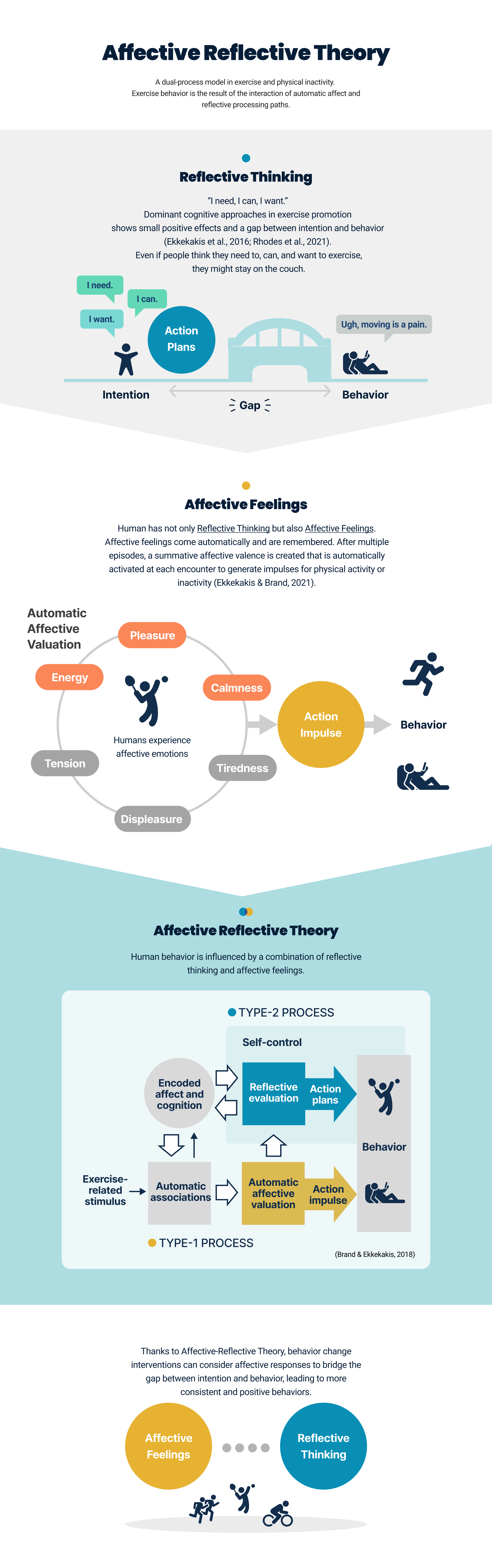
The Affective-reflective theory is a type of dual process model, which says that exercise behavior is the result of the interaction of automatic affect and reflective processing paths.
This theory started from a criticism of the current dominant approach in exercise behavior change and motivation. Reflective thinking is centered on these approaches, also known as a cognitivist approach. “I need, I can, and I want” represents prominent theories respectively, taking a risk of oversimplification. “I need” means a theory of planned behavior from Ajzen and Schmidt that focuses on the intention. “I can” refers to a social cognitive theory from Bandura that emphasizes perceived self-efficacy. “I want” symbolizes a self-determination theory by Deci and Ryan that pays attention to intrinsic and extrinsic motivation. These dominant cognitive approaches, unfortunately, showed small positive effects and a gap between intention and behavior. The affective-reflective theory points out this gap. Even if people think they need to, they can, and they want to do exercise, they might stay on the couch instead while feeling “ugh moving is a pain.”
Human has not only reflective thinking but also affective feelings. This is the most distinctive difference in the affective-reflective theory. Affective feelings come automatically. For example, people feel energy, pleasure, and calmness when they run outside. The same people may feel tension, displeasure, and tiredness when they work out at a gym. After multiple, presumably diverse, episodes of these exercises, the same people may create a summative affective valence. For those people, running outside is tagged with energy, pleasure, and calmness while working out at a gym could be tagged with feeling tension, displeasure, and tiredness. This summative affective valence will be automatically activated at each encounter. Whenever they hear and come up with running outside and working out at a gym, automatic affect valuation generates impulses for physical activity or inactivity.
The automatic affective process has not been interested in other behavior change theories. This theory borrows an idea in the field theory by Kurt Lewin, in that the sum of driving forces and restraining forces impact a person's behavior. Affective process to exercise and physical activity can be a driving force to continue or change the behavior or can be a restraining force to stop or avoid changes.
To sum up, the theory shows this graphic illustration under the notion that human behavior is influenced by a combination of reflective thinking and affective feelings.
The theory starts at the very moment at which an exercise-related stimulus happens. It can be either external or internal. External stimuli can be hearing a doctor’s advice to start exercising while internal stimuli could be remembering the doctor’s advice to exercise. A stimulus triggers automatic associations, for example, the individual’s current, momentary state of physical inactivity. The individual has automatic affective valuation and the action impulse as a driving or restraining force to change the present state. It is important to note that the automatic affective valuation is a tacit assignment of positive or negative valence. This is called a type-1 process because it comes first and automatically. The type-2 process is a reflective evaluation. Both automatic affective valuation and encoded affect and cognition serve as the basis for a reflective evaluation. This response makes action plan(s). The action plan and the action impulse can be concordant or discrepant, which makes a sum of driving forces and restraining forces.
This theory explains that the availability of self-control resources determines whether the predominant influence on behavior would be type-1 or type-2 processing. In other words, if people have a lack of self-control resources, they might use type-1 processing dominantly.
Affective-Reflective Theory opens a new possibility for behavior change interventions. Researchers can consider affective responses to include better and appropriate behavior change techniques, which hopes to bridge the gap between intention and behavior, leading to more consistent and positive behaviors. Limitations of this theory are, first this is a comparatively new theory that has not been tested enough to provide definitive evidence, second, the difficulties of measuring affect and emotions question the implication in practical interventions.